Going forward, some of the photos presented in this blog will be presented in a new format. HDR (HIgh Dynamic Range) images, when viewed with a compatible device and browser, reveal a more true-to-life appearance: brighter highlights, deeper shadows, more vivid colors. For more information, visit the Greg Benz Photography website. There you will find many sample images, tests to see if your devices are HDR capable (and if so, how to best configure them), and tips on how to create your own HDR photos.
Talk about great timing! We landed in Paris on June 24, smack during the record heat wave when the high temperature was over 100°. Did we pack enough lightweight clothes? No. Were we physically prepared for the heat? Hell, no. We did have two tubes of sunscreen in our luggage to deal with the relentless sunshine.
It was in the high 80’s when we landed at Charles de Gaulle Airport. The thought of getting into a Métro with hundreds of other hot and sweaty travelers and then schlepping the luggage several blocks wasn’t appealing, so we took a cab to our hotel. We couldn’t check in for a couple of hours. We lounged around the lobby and ducked out briefly for lunch. Finally we got into our room, which was weakly air conditioned. The hotel staff fixed the problem and brought up a fan to circulate air better. We stayed comfortable thereafter.
We spent the next day going between the various buildings of Galeries Lafayette, the department store near the old Paris Opera. We both bought a few things to get through the heat. On the way to the Métro station, we went through a public art installation on the Pont Neuf – La Caverne. The last thing that appealed to me in the heat was going through an oversized circus tent “cavern” and dodging umpteen tourists taking selfies. In addition, the traffic through La Caverne was one-way, and pedestrians had to detour onto another bridge to get back to the Left Bank. This did not make my knees happy.
The last full day of the heat wave we took the Métro and walked to Montparnasse to have lunch at La Coupole, a classic French bistro. Thereafter, we hit up Librairie Gourmande and got a couple of cookbooks (in English) to add to the collection.
The heat wave began to break late on the 27th, when it began to rain. This was a big relief for all. France reported over 1000 extra deaths due to the heat, as a result of heat stroke or drowning. One hopes that this is not a regular summer occurrence in Europe.
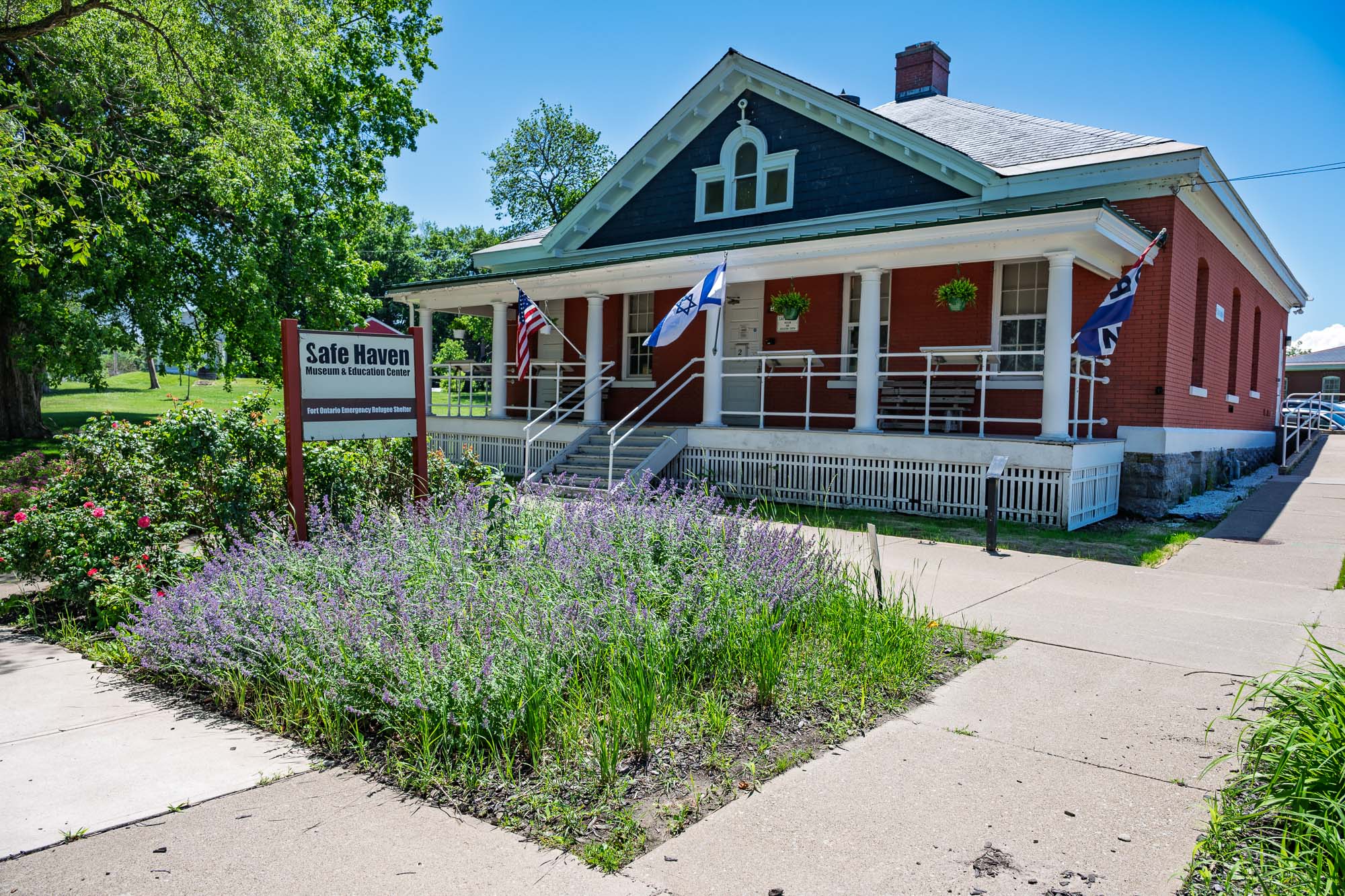
The Safe Haven Museum in Oswego, New York. Photo courtesy of Julian Vrieslander.
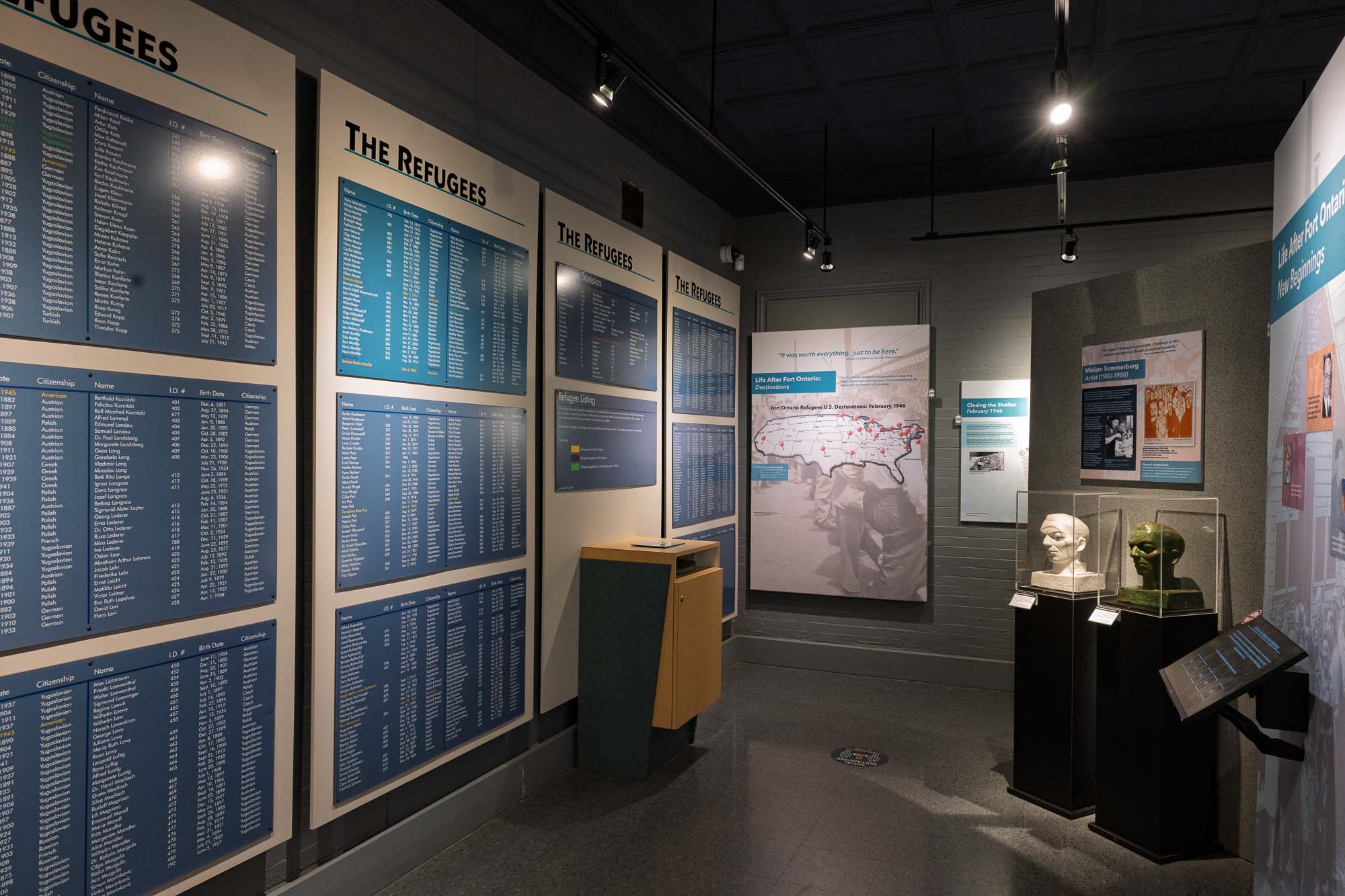
We visited my home county in New York in June for my great-niece’s high school graduation. We were having breakfast at a restaurant in Oswego and noticed a sign for the Safe Haven Museum. I asked the proprietor what it was, and she said, “I’m not sure, but these women [at a neighboring table] can tell you.” It turns out that this museum commemorates the resettlement of 982 European refugees during World War II. I’d heard the bare bones of the story before, but not the details. After breakfast, we drove over to see it. The museum is housed in the former administration building at Fort Ontario, a decommissioned Army base that’s now part of the New York State Park System. In 1944, President Frankin Roosevelt wanted to bring refugees to the United States, but Congress was having none of it. He then signed an Executive Order to bring a boatload of refugees here, but each family had to sign an affidavit that they would leave the country at the end of the war. Many of the refugees were from Yugoslavia, as they could escape to Italy easier than people from other countries. Most of the refugees were Jewish. The ship left Italy and landed at Ellis Island, then the refugees boarded trains to Oswego and were housed in barracks at Fort Ontario. The first sight of Fort Ontario for the refugees wasn’t encouraging: barbed-wire fencing and lines of barracks. Fortunately, the residents welcomed the newcomers after the initial quarantine period. First Lady Eleanor Roosevelt came to visit. Children attended local schools. Musicians in the refugee camp played concerts. Any resistance to the refugees was outweighed by the friendships made with Oswego residents. Roosevelt died in April 1945, and Germany surrendered the following month. President Harry Truman decided that the refugees should be given the option to stay in the US. The museum didn’t give his motivation for doing so. He may have been concerned about the Soviet Union’s bringing eastern Europe under its sphere of influence, or perhaps he was worried about post-war conditions on the continent. Nevertheless, he went ahead with the plan. Most refugees stayed in the US and became citizens. Many Nazi-era refugees were sponsored by academic institutions, churches, and family members. Albert Einstein had offers from several universities but settled at the Institute of Advanced Studies at Princeton. Jewish children and “enemies of the Third Reich” were brought to America by religious groups. See the Ken Burns film, Defying the Nazis, for one story. In contrast, the Fort Ontario refugees were the only ones who were brought by the government. This story deserves to be known by more people, and stands in stark contrast to the current administration’s treatment of refugees.
A partial list of the refugees brought to Fort Ontario in 1944. Photo courtesy of Julian Vrieslander.
Regular readers will recall that I trashed my left knee on a so-called family-friendly hike in Switzerland. I didn’t seek attention there because most of our destinations lacked medical facilities. I waited until I returned to the States to see a doctor. This is the saga of the knee over the last ten months.
United States. My primary care doc referred me to an orthopedic surgeon and ordered physical therapy (PT). I started the latter before I saw the former. He offered me a cortisone shot, but I wasn’t ready to have one yet. I wanted to see the progress I could make with PT first. I was doing well with therapy, but decided that a cortisone shot might be a good idea before this year’s vacation to France and the Netherlands. I thought I could get a shot soon before we left, so I procrastinated. Turns out I couldn’t get one with my doctor until after I got back from Europe. So I decided I’d tough it out.
France. Toughing it out was a poor idea. Our rental apartment was in the same walk-up we stayed in three years ago. The combination of going up and down those stairs (with no handrail) several times a day and walking around Paris put me in extreme pain. A grad school crony who lives in Paris sent me a list of emergency rooms near where we were staying. I limped into the Hôtel-Dieu emergency room around the corner from Notre Dame the day before Easter. The room wasn’t crowded. I got in to see the triage nurse quickly. It took a bit longer to see the attending physician, who told me that only rheumatologists are allowed to give cortisone shots in France and he wasn’t one. Instead, he gave me a prescription for Tylenol with opium, which did a number on my gastrointestinal tract. (I can’t take aspirin, ibuprofen, or naproxen due to potential bleeding issues.) I rested in the apartment for one full day and slowly got back to walking around. I managed to get through the Cordon Bleu class without too much suffering, but I knew I needed a shot to survive walking around Normandy and Brittany.
Netherlands. Julian’s cousin did some research and found an urgent care clinic in Amsterdam’s central train station that specializes in treating travelers. I managed to get an appointment with them the day after we arrived. Jackpot! I was able to get the cortisone shot there, and probably for much less that it would have cost me in the US. The doctor was very pleasant and chatty. He actually lived in Seattle for a short time in his younger days. AND the shot worked! I’m still pain-free two weeks later.
Moral of story. If you’re going to have knee problems, do so in the Netherlands. First, the terrain is flat, and you don’t have to deal with stairs in subways like in Paris. Second, you can get treated quickly in Amsterdam.
Julian gave me a croissant and brioche class at Le Cordon Bleu for Christmas. Actually, I think it was more a gift for him, expecting me to bake these items on a regular basis. I had to rest my knees for a couple of days so I could participate in the class.
We took the Métro subway to a stop near the campus. The school is not housed in the same place where Julia Child took classes. The campus is southwest of the Eiffel Tower. The building resembles an oversized pizza box with picture windows overlooking the Seine. The first floor has a café, one large classroom, and a small store. We had lunch at the café while waiting for my class to start.
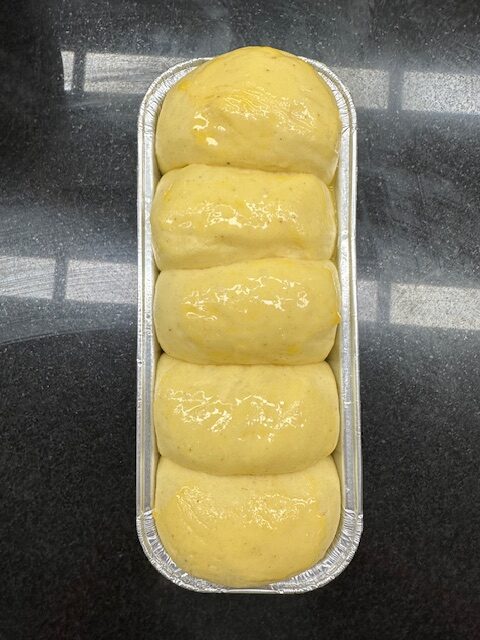
The class was conducted in French and English. Most of the students were American, Canadian, or British, with some French and Asian people mixed in. The doughs were pre-made. The first thing the instructor did was to demonstrate the lamination method of enrobing the butter in dough, then folding it. Temperature is critical at this step, because you don’t want the butter to leak out. We refrigerated the dough, then repeated the process. At this stage, the instructor took our doughs and ran it through a glorified pasta maker to get it to the right thickness. Thereafter, we shaped six croissants and six pains au chocolats. These rose while we shaped six brioche rolls and one brioche loaf.
The finished croissants and pains au chocolats.
Brioche loaf prior to baking.
I was surprised by several features of the school. The instructor, translator, and teaching assistants were all friendly and helpful to those of us who aren’t professionals. All of the stoves were induction, not gas. I asked the translator about this during a break and she said it was for safety reasons. There was probably an environmental reason as well, given gas fumes and the prospect of having ten stovetops going full blast in a classroom during the summer. The instructor also confessed that most bakeries in France do not do the croissant preparation themselves (quelle horreur!). The café on the first floor was reasonably priced. Tuition for a full culinary education is $69,000, so it helps that students can afford to eat there.
Meanwhile, Julian peeked in on a class on the first floor before walking back to Île St. Louis. The lesson of the day was foie gras (fatty goose liver) with a fig sauce. Each student received a whole foie gras and had to dissect out the arteries before cooking. Julian’s comment: “Some were better than others.” It pays to take anatomy; otherwise, you could wind up with a true crise de foie (crisis of the liver – foie gras is very expensive).
At the end of the workshop, we got to take home our recipe booklet, a Cordon Bleu apron, insulated bag, pencil, and our creations. We also had a “graduation ceremony”, where students received their certificates of completion to show their family and friends. I only took back to our apartment the brioche loaf, two brioche rolls, and two each of the croissants and pains au chocolats. The rest found good homes with full-time students and staff. The brioche loaf was sturdy enough to travel to Julian’s cousin’s house outside Amsterdam, where it made some fine French toast.
You need not go all the way to Paris to learn how to make croissants. One friend went to a class at the Chicago Sur La Table a couple of years ago. However, if you’re going to be in Paris and want the full experience (and can afford the fee), I recommend Le Cordon Bleu. It’ll be worth your time.
We were in Paris last week. We rented an apartment in the same building where we stayed three years ago. Unfortunately, the years have taken a toll on my knees. As a result, moving around the city – and even in and out of the building – has been painful.
One of the original issues with Paris hosting the 2024 Paralympic Games was access. Many of the Métro stations do not have escalators or elevators, and many venues aren’t accessible to wheelchair users. On Île St. Louis, where we’re staying, most restaurants and shops have one or two steep steps by which to enter. Perhaps a few Métro stops have been retrofitted, but very few that we’ve traveled through. Finding ramps is an even bigger challenge. As a result, folks who use wheelchairs or walkers may be shut out of most establishments.
I understand that some of the reluctance to upgrade for access is due to the historic value of the buildings. In addition, cost is a major consideration. However, mobility-impaired people need access to work and recreation. Upgrades are long overdue.
It was Monday March 16, 2020. Our hospital had received seriously ill patients with Covid-19 from the hospital near the rehab facility that was the epicenter of the outbreak. The Friday before, my pool closed due to the outbreak. Around 10 am, my manager went from cubicle to cubicle to send us all to work from home. Five years later, we’re still doing so.
While remote working may have protected us from getting the virus in the office, it has produced a plethora of other consequences. Isolation from coworkers has been the major one. Instead of just walking down the aisle to ask a question, you have to email or text to set up a virtual meeting. There’s no such thing as a chance encounter in the elevator or an impromptu conversation in the break room or bathroom. People get married, have babies, leave jobs, retire, or even die without much acknowledgment. This lack of recognition contributes to the decline in company culture and cohesion.
Along with isolation, technical glitches can disrupt workflow. The remote login may not work. Upgrades to hardware or software may be slow or non-existent. If there’s a problem with hardware, no computer person will make a house call to swap out a monitor or mouse that’s not functioning. You either have to drive somewhere to pick up the new item or wait on a delivery.
Will we go back to working in the office, at least part time? Probably not. There had been talk after a year or two of “hotel spaces”, where employees sign up to occupy desks for two-hour stretches. That time limit was impractical for our purposes; in addition, there was no space available to set up these desks. This runs counter to many private companies that are forcing employees to return to the office for at least three days a week or risk losing their jobs. So we’ll be working from home until we retire.
For Valentine’s Day 2025, we skipped the crowds at local restaurants. Instead, Julian and I stayed at home and joined forces to prepare a French-themed dinner. For several years, he had been wanting to try his hand at making cassoulet. We had even bought the imported dried tarbais beans (traditional for this dish), and they were waiting patiently in the back of the cupboard. We decided to make a tourtière for dessert. Both items got our usual mix of improvisations and shortcuts. More on this below.
In Paula Wolfert’s book, The Cooking of South-West France, she devoted an entire chapter to cassoulet, describing her travels through the region to taste and compare local variations of this dish. The common features are simple: a baked casserole of beans and meats: pork, sausage, and confit (duck or goose, preserved in its own fat).
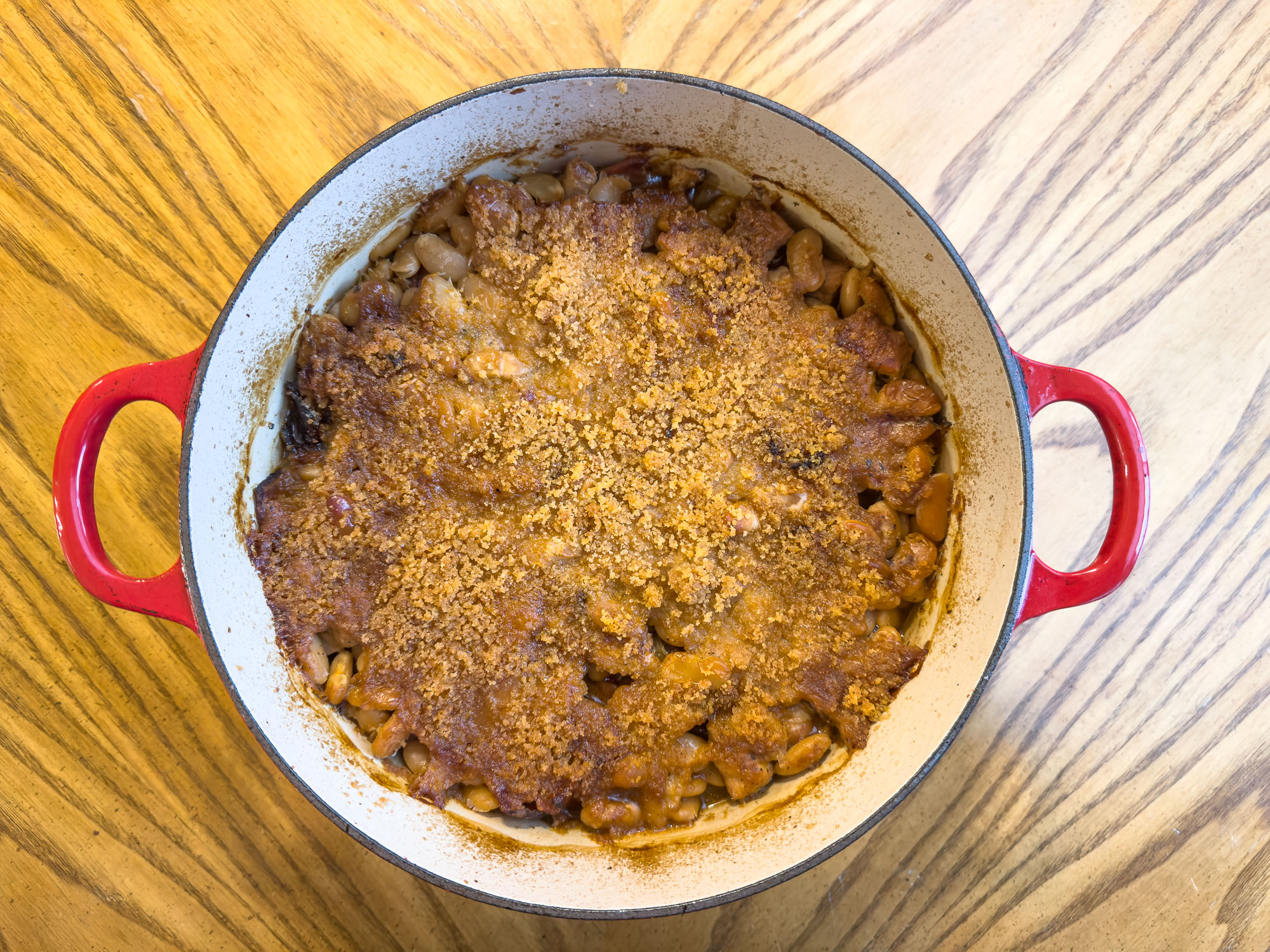
A traditional preparation of cassoulet can take many hours, or even several days. To simplify the project, we vamped on a recipe from the latest edition of Joy of Cooking. We used preserved duck legs (confit de canard) from a local grocery, cans of low-sodium chicken broth, lean pork chops, bacon, and andouille sausage. We soaked the beans overnight and parboiled them the next morning with a pinch of baking soda. After draining the beans, we added broth, garlic, onion, tomato paste, parsley and thyme. While the beans cooked, we fried the bacon and browned the meats in the rendered fat. The beans and meats were layered in a Dutch oven, topped with breadcrumbs, and baked for several hours. Below is the final product.
Our first encounter with cassoulet was at a Seattle restaurant that prides itself on authentic French cuisine. Their version was not impressive. I think ours was better – not as overwhelmingly fatty and salty as the one from that restaurant.
It’s interesting to compare cassoulet with an American classic: Boston baked beans. We use the authentic 19th century recipe from the now-defunct Durgin Park restaurant in Boston. That recipe is quite simple, consisting only of navy beans, salt pork, molasses, sugar, onion, dry mustard, salt and pepper. The American style of baked beans usually has a strong sugary flavor note that competes with the saltiness of the pork. You may or may not prefer that to a rich meat-forward cassoulet. We also like other variants of the baked beans and meat theme. One is feijoada, the national dish of Brazil. See this blog post for details. There’s also Cajun red beans and rice.
The tourtière recipe had an apple-date filling. Instead of the phyllo dough, I used a conventional all-butter pie pastry. I cut the filling recipe down by a third, fearing that it wouldn’t fit in the pie pan. I should have used the whole recipe, as the ratio of filling to crust was too small. I also added some cinnamon to turn up the taste volume. If I make this again, I’ll do the phyllo crust
.Maybe next year we’ll do steak and baked potatoes for Valentine’s Day. They’ll take less time to prepare and won’t cost an arm and six legs. (Duck confit and tarbais beans aren’t cheap.) However, a little experimentation in the kitchen is good to sharpen one’s skills.
You may have noticed a lack of new content in the last seven months. I’ve been swamped with work and other issues to add new posts. Therefore, edible thoughts.com is being put on hiatus. It may be resurrected in the future. Thanks for reading.


Recent Comments